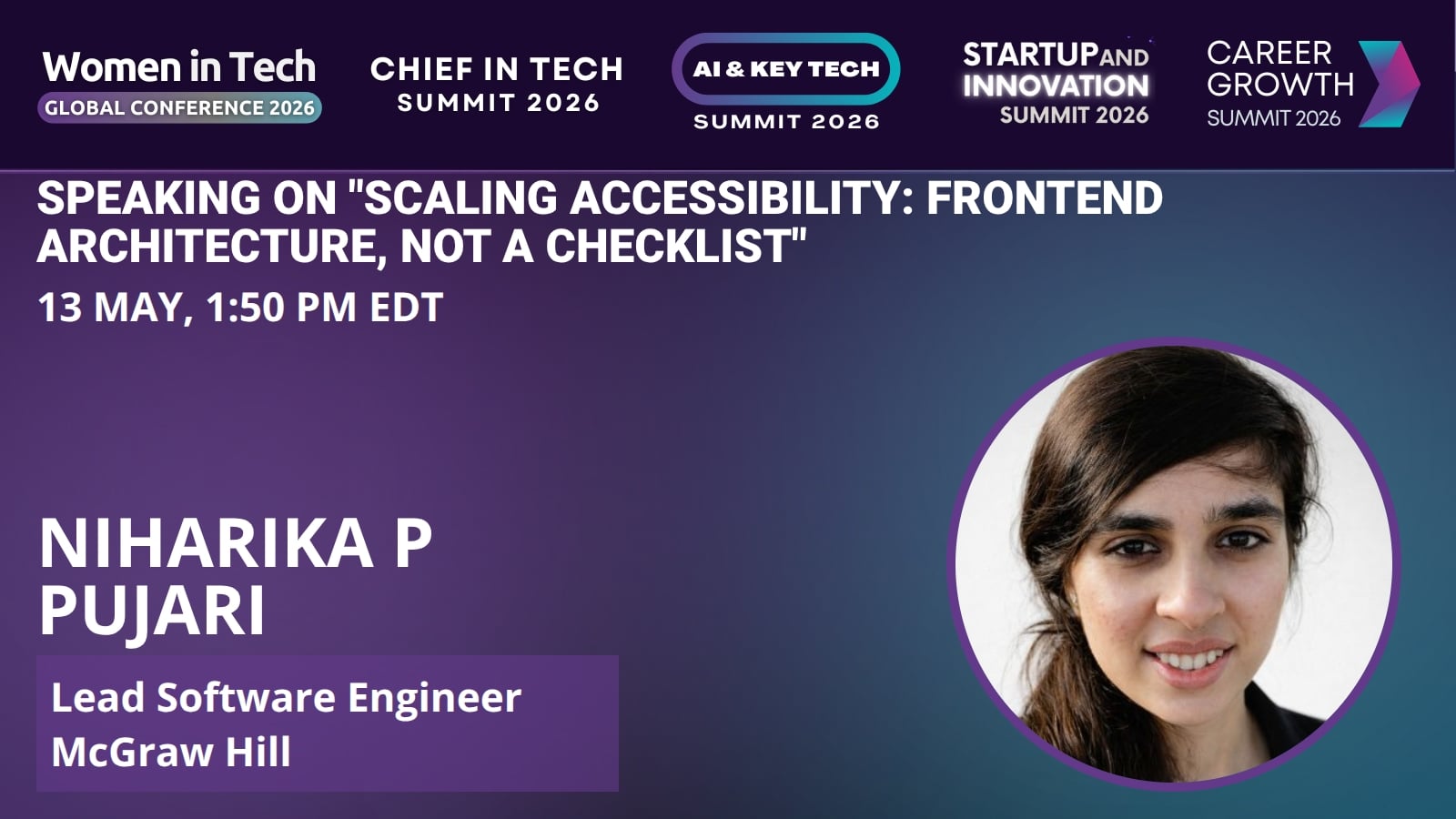

Niharika P
Pujari
Lead Software Engineer at McGraw Hill

"Scaling Accessibility: Frontend Architecture, Not a Checklist"
"Scaling Accessibility: Frontend Architecture, Not a Checklist"
Wed May 13 - 1:50 PM EDT/New York (See in local time)
Add to Calendar
05/13/2026 1:50 PM
05/13/2026 02:30 PM
America/New_York
#WTGC2026
"Scaling Accessibility: Frontend Architecture, Not a Checklist"
#WTGC2026
"Scaling Accessibility: Frontend Architecture, Not a Checklist"
https://www.womentech.net/ringcentral
https://www.womentech.net/ringcentral
"Scaling Accessibility: Frontend Architecture, Not a Checklist"
"Scaling Accessibility: Frontend Architecture, Not a Checklist"
Don’t miss out and join visionaries, innovators, and thought leaders from all over the world at the Women in Tech Global Conference.
Vote by Sharing
Unite 100 000 Women in Tech to Drive Change with Purpose and Impact.
Do you want to see this session? Help increase the sharing count and the session visibility. Sessions with +10 votes will be available to career ticket holders.
Please note that it might take some time until your share & vote is reflected.
Session: Scaling Accessibility: Frontend Architecture, Not a Checklist
Most teams approach accessibility through training, audits, or late-stage QA. While these efforts are important, they don’t scale - especially as frontend codebases grow more complex and teams rely on shared components and design systems.In this talk, I’ll reframe accessibility as a frontend architecture concern and a leadership responsibility, not just an individual skill or compliance task. We’ll look at how accessibility outcomes are shaped by architectural decisions - component APIs, state and focus management, and system-level defaults and why fixing issues after implementation leads to recurring accessibility debt.
I’ll walk through how to shift accessibility left across the frontend lifecycle: from design constraints and reusable patterns, to accessible component primitives, to automated feedback that catches regressions early. Finally, we’ll explore the role of frontend leads in making accessibility stick - by setting standards, enabling teams, and measuring success beyond checklists.
Key Takeaways
- Explain why common accessibility approaches don’t scale in modern frontend teams
- Apply “shift left” principles to accessibility in design, development, and CI
- Influence accessibility adoption across teams without slowing delivery
Bio
Hi, I’m Niharika P. Pujari, a Lead Software Engineer at McGraw-Hill with over eight years of experience building and maintaining large-scale web applications. I work in the higher education space, where my focus is on designing frontend-driven, accessible experiences that support instructors, institutions, and learners at scale.I specialize in frontend development with Angular, with a strong emphasis on web accessibility as a core part of engineering—not an afterthought. My work centers on creating inclusive, user-centric interfaces, embedding accessibility into component design, frontend architecture, and team workflows to ensure products meet both user needs and compliance standards.
Alongside my frontend work, I’ve been expanding my skills in AWS through hands-on learning and certifications to better support scalable, reliable systems. I’m passionate about writing clean, maintainable code, mentoring engineers, and continuously learning, and I’m particularly interested in how artificial intelligence can be applied responsibly to improve learning experiences and student outcomes.